
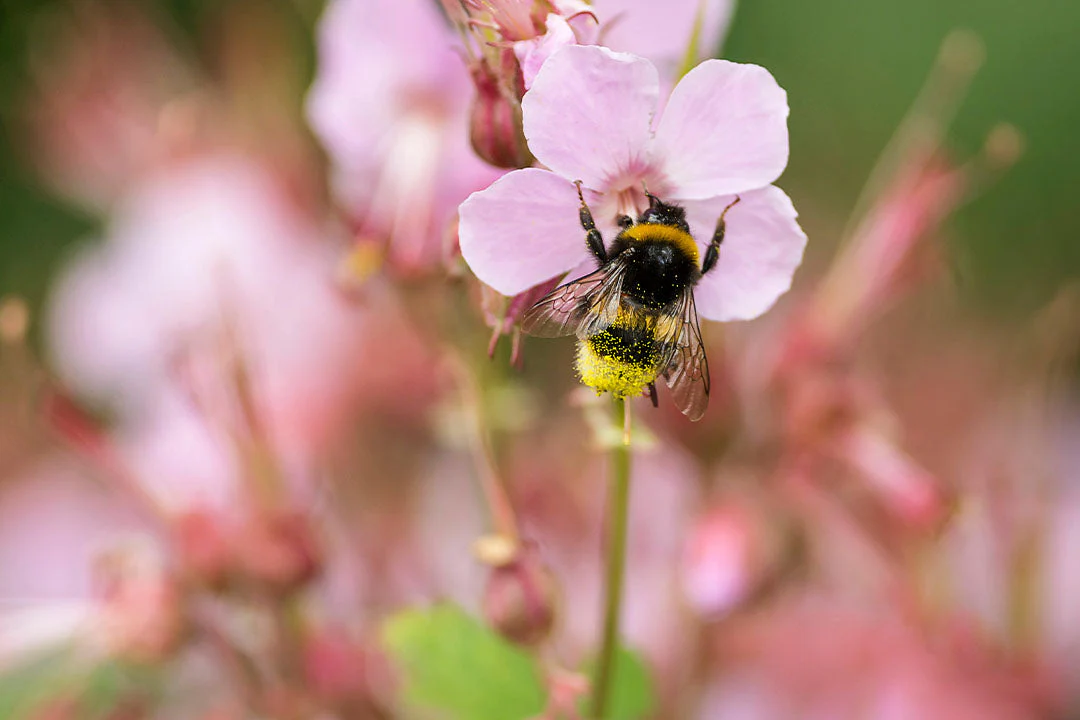
Successful fruit growing in Britain depends as much on wildlife as it does on pruning, soil, and weather. Bees remain the most important pollinators for apple trees and many other orchard crops, yet their populations continue to face pressure from habitat loss and limited forage. Orchard owners, whether managing a few trees in a garden or a larger mixed planting, can improve pollination reliability by integrating the right flowering plants alongside fruit trees. Choosing flowers that attract bees before, during, and after blossom helps stabilise yields and supports wider biodiversity. For those planning to buy fruit trees, understanding how companion planting improves long-term performance is increasingly part of responsible orchard design.
Fruit trees rely on insects to move pollen between flowers, particularly apples, pears, plums, and cherries. While wind plays a minor role, bees do the majority of effective work, especially in the cooler and often unpredictable British spring. Encouraging bees to remain within the orchard area requires a steady supply of nectar and pollen, not only during the brief flowering period of fruit trees but across the growing season.
The fruit trees specialists at https://www.fruit-trees.com/ nursery often advise growers to think beyond the trees themselves. In their experience, orchards supported by flowering groundcover and perimeter plants show more consistent fruit set, particularly in years when spring weather disrupts bee activity. Their guidance on apple highlights how pollination partners and orchard biodiversity influence cropping success, especially for traditional and heritage varieties grown in the UK.
Why Flowers Matter More Than Hives
Many orchard owners assume that adding beehives is the most direct solution to pollination problems. While managed honey bees can help, they are not always the most efficient pollinators in cool or wet conditions. Native bumblebees and solitary bees are often more active earlier in the year and can forage at lower temperatures. These wild pollinators depend heavily on diverse flowering plants for survival.
Flowers within and around orchards provide forage continuity. Early-flowering species support bees emerging from winter, while summer and autumn blooms sustain colonies after fruit trees have finished flowering. This continuity increases the likelihood that bees will already be present when apple blossom opens, reducing reliance on chance visits. In addition, flowering plants can improve soil health, suppress weeds, and create a more balanced orchard ecosystem. Over time, orchards with diverse planting tend to experience fewer pest outbreaks and better overall resilience.
Crocus and Snowdrop: Early Season Lifelines
One of the biggest challenges for British pollinators is the lack of nectar in late winter and early spring. Crocus and snowdrops address this gap effectively. These bulbs flower from February onwards, often pushing through frost and light snow. For bees emerging on warmer days, they can be the only available food source.
Planting crocus beneath apple trees or along orchard paths makes efficient use of space, as they complete their growth cycle before tree canopies leaf out. Snowdrops thrive in similar conditions and naturalise well over time. While they may seem ornamental, their value to early bumblebees is significant. By supporting pollinators before fruit trees bloom, these flowers help ensure bees are established and active when pollination becomes critical.
Wild Primrose and Cowslip: Native Reliability
Native wildflowers such as primrose and cowslip are well adapted to British soils and climate. They flower in early to mid-spring, overlapping neatly with apple blossom. Their open flower structure is accessible to a wide range of pollinators, including short-tongued bees that may struggle with more complex blooms.
These plants suit orchard edges, banks, and less-managed grassy areas. Once established, they require little maintenance and tolerate partial shade, making them ideal under taller fruit trees. Using native species also supports broader biodiversity, including butterflies and beneficial insects. For traditional orchards or those aiming for a naturalistic approach, primroses and cowslips fit seamlessly into the landscape while delivering tangible pollination benefits.
Comfrey: The Workhorse Plant
Comfrey is widely regarded as one of the most useful companion plants in orchards. Flowering from late spring into summer, it produces abundant nectar that attracts bees in large numbers. Its deep roots draw up nutrients from lower soil layers, improving soil structure and fertility when leaves are cut and used as mulch.
In apple orchards, comfrey planted at the drip line of trees serves multiple functions. It supports pollinators during and after blossom, suppresses competing weeds, and contributes organic matter. British growers often favour sterile varieties that do not self-seed aggressively. Over time, comfrey becomes a permanent part of the orchard system, reducing reliance on external inputs while maintaining strong bee activity throughout the season.
Phacelia: Fast-Growing Bee Magnet
Phacelia has gained popularity among UK farmers and orchardists for good reason. It germinates quickly, flowers within weeks, and produces dense clusters of nectar-rich blooms. Bees are drawn to it in large numbers, making it particularly useful in newly planted orchards where permanent flowering plants are still establishing.
This annual can be sown between tree rows or in spare patches of ground. It improves soil health by adding organic matter and can be incorporated back into the soil after flowering. Phacelia’s flowering period often bridges the gap between spring blossom and summer forage, keeping bees present in the orchard when fruit trees have finished flowering but still benefit from ongoing insect activity.
Lavender and Borage: Summer Support
While apple trees flower in spring, maintaining pollinator populations through summer ensures stronger colonies that return the following year. Lavender and borage excel in this role. Lavender thrives in well-drained soils and sunny positions, common conditions at orchard margins. Its long flowering period and strong scent attract both honey bees and bumblebees.
Borage, an annual with star-shaped blue flowers, is particularly attractive to bees and easy to grow from seed. It flowers continuously through summer and often self-seeds gently. Including these plants extends the orchard’s usefulness to pollinators beyond fruiting season, contributing to long-term stability rather than short-term gains.
Red Clover and Meadow Mixes
For larger orchards or those with grass alleys, red clover offers a practical solution. It fixes nitrogen, improving soil fertility, and provides nectar for long-tongued bees such as bumblebees. Allowing sections of orchard grass to flower rather than mowing constantly increases habitat value significantly.
Meadow-style planting with mixed native flowers can transform underused spaces into productive pollinator zones. These areas require thoughtful management, usually involving one or two cuts per year, but the benefits extend beyond bees. Improved soil structure, reduced erosion, and enhanced visual appeal all contribute to a healthier orchard environment. For growers balancing productivity with sustainability, meadow planting is increasingly seen as best practice.
Integrating Flowers Without Compromising Yield
Some orchard owners worry that flowers compete with fruit trees for water and nutrients. In practice, well-chosen companion plants often improve tree performance rather than reduce it. Deep-rooted species draw nutrients from below the tree’s main root zone, while groundcover reduces evaporation and moderates soil temperature.
The key lies in thoughtful placement. Flowers should complement tree spacing and not interfere with harvesting or maintenance. Over time, the increased pollination efficiency and improved soil health typically outweigh any minor competition. For those establishing new orchards, planning flower integration from the outset is simpler than retrofitting later.
A Practical Approach for British Orchards
Bee-attracting flowers are not a decorative afterthought but a functional component of orchard design. In Britain’s variable climate, supporting a diverse range of pollinators improves reliability year after year. From early bulbs like crocus to summer stalwarts such as lavender and clover, each plant plays a role in maintaining bee presence across the seasons.
Whether managing a few apple trees in a garden or planning a larger planting, integrating these flowers supports healthier trees and more consistent harvests. Combined with good tree selection, appropriate rootstocks, and sound management, pollinator-friendly planting helps future-proof orchards. As more growers recognise the link between biodiversity and productivity, flower-rich orchards are becoming the norm rather than the exception.

